
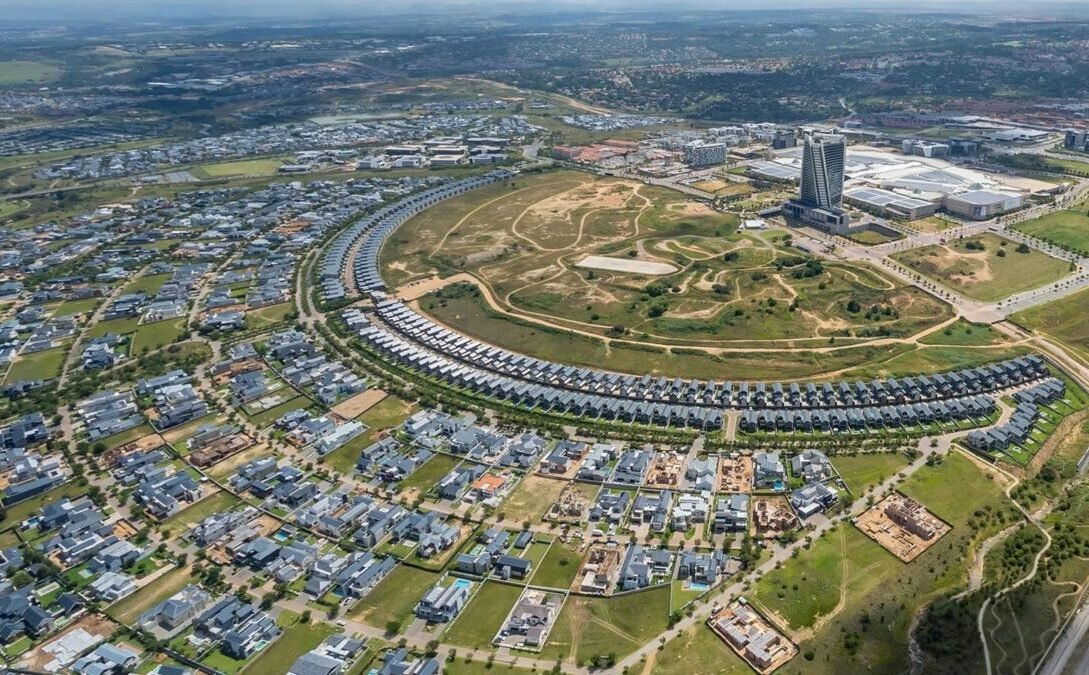
Waterfall City in Midrand is one of South Africa’s premier smart cities, serving as an economic hub in Gauteng while operating under a leasehold rather than ownership model.
The precinct is blanketed by a carrier-neutral, open-access fibre network operated by Waterfall Access Networks (WAN), which provides fibre line rental access to Internet Service Providers (ISPs).
Any acknowledged ISP that has an agreement with WAN can access and use its network infrastructure in Waterfall, within the prescribed WAN commercial and technical parameters.
“WAN has brought in some of the world’s best cutting-edge networking technologies through DasanZhone GPON and Active Ethernet,” the company said.
“Due to this, our network is geared to deliver some of the fastest transfer rates in Africa.”
The 2,200-hectare precinct, which falls under the City of Johannesburg, is built on land that cannot be bought or sold because it is a waqf, an Islamic charitable endowment.
This means every resident and business operates under a 99-year leasehold agreement rather than freehold or sectional title ownership.
The land is owned by the Waterfall Islamic Institute (WIC). It was founded by the Mia family, who bought the original farm in 1934 for £16,000 from an insolvent estate.
Adjusting for inflation using the Bank of England’s official inflation calculator, that would be roughly £1,003,155 in 2026, or R22.5 million.
The Rand was introduced in 1961 when South Africa became a Republic. As a former British colony, it had continued to use pounds until then.
South African pounds were at parity with the UK pound sterling in 1934 after a brief decoupling when the UK abandoned the gold standard in 1931.
Under waqf principles, the land on which Waterfall City is built is dedicated to Allah and the community. All profits must be used to fund charities, including education and various social projects.
For property investors, this structure offers distinct advantages and disadvantages. For one, because land is never “transferred” in the typical sense, buyers are currently exempt from transfer duties.
“Transfer fees can be exorbitant, so I would say that this is appealing for an investor,” prominent property expert Ash Müller, of Ask Ash, has stated.
Müller also explained that lease agreements are registered at the Pretoria Deeds Office, which is not the norm for leases.
“They are renewable after the 99-year period with an infinite number of extensions. The lease cannot be cancelled,” she said.
“You can sell your property at any time during the 99-year lease, and the new owner will receive a brand new 99-year lease.”